
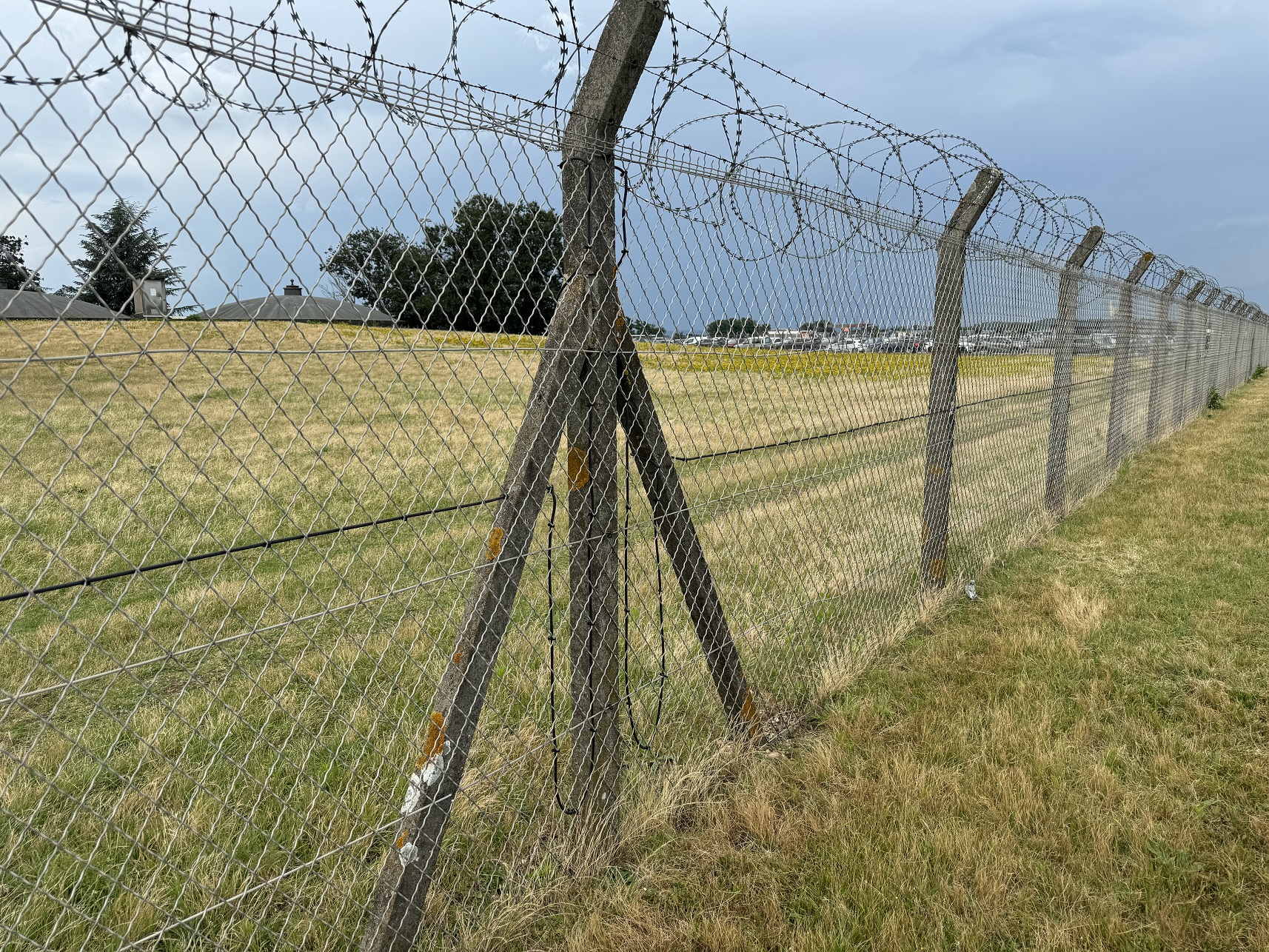
Between mid-September and early October 2026, three incidents at air bases in Australia and the United Kingdom put perimeter security back in the headlines.
On 14 September, a man allegedly entered RAAF Base Darwin, assaulted a member of the Australian Defence Force and drove off in a stolen security vehicle, which put the base into lockdown and started a police search down the Stuart Highway. Two weeks later, UK counter-terrorism police arrested five men near RAF Fairford, a base used by US forces, on suspicion of preparing a terrorist act, and the number of arrests later rose to seven. Then on 8 October, a security patrol at RAF Molesworth in Cambridgeshire, which hosts US and NATO intelligence functions, found an abandoned vehicle and a small breach in the perimeter fence, and two men were arrested on the base.
The same pattern is playing out offshore. Over the 2025 to 2026 New Year period, telecom cables linking Finland, Estonia, Sweden, Latvia and Lithuania were damaged within days of each other, adding to a run of Baltic incidents since 2023 in which investigators have examined ships suspected of dragging their anchors across the seabed. Taiwan has detained vessels suspected of cutting undersea cables around its outlying islands. At the Shangri-La Dialogue in Singapore at the end of May, the AUKUS partners launched a Pillar Two initiative to develop uncrewed undersea systems that protect seabed infrastructure, and Australia’s Defence Minister Richard Marles put the concern plainly: “The seabed is a battlefield.” FFT welcomed the new AUKUS focus on protecting subsea cables and other critical undersea infrastructure, a sign of how seriously governments now treat the security of these assets.

The headlines involve alliances, intelligence hubs and international cable systems. The response always lands somewhere specific: a particular stretch of fence at a particular base, a landing station where a cable comes ashore, and a control room that needs to know within seconds what is happening and exactly where.
For the people who specify and run security at these sites, the most useful question each new incident raises is what it says about their own perimeter, and how quickly they would know if the same thing happened there.
Air bases and defence estates share a set of characteristics that make the perimeter both critical and difficult to cover well.

Subsea cables carry the data, financial transactions and, increasingly, the electricity that flows between countries. In the Baltic, the Estlink 2 power cable between Finland and Estonia was damaged on the same day in December 2024 as four telecom lines.
The deep-ocean sections of these cables are hard for anyone to reach. The most exposed stretch sits close to shore, where the water is shallow enough for anchors and fishing gear to reach the seabed, and where the cable runs up the beach to a landing station. The Baltic incidents investigated so far have centred on anchors dragged across relatively shallow seabed, with drag tracks found in at least one case.
That shore end is also the part an operator can monitor directly and act on. The landing station is a high-value site on land with its own fence line, and the cable route from the landing station out to the first repeater is where FFT focuses its subsea cable monitoring, because it is where anchor drag, trawling and deliberate interference concentrate. For a defence department or a telecom operator, protecting a subsea link starts with the same perimeter thinking that protects an air base.
Fibre optic sensing works the same way on a base fence, along a buried cable route and at a landing station, because the fibre itself is the sensor. Pulses of light travel along the cable, and any disturbance (a climb, a cut, footsteps, digging, a vehicle or an anchor) changes the light that returns to the control unit. The system reads that change, identifies what caused it and pinpoints where along the cable it happened.
FFT’s Aura Ai-X applies this to fences, buried perimeters and cable routes. The sensing cable is passive in the field, with all power and electronics housed in a secure equipment room, so there is nothing on the fence line to power, maintain or tamper with, and the cable is unaffected by lightning and electromagnetic interference around radar, communications and high-voltage equipment.
Deep learning classifies every event signature in real time, telling a person climbing the fence apart from wind, rain, wildlife or the vibration of an aircraft on the runway. That keeps nuisance alarms close to zero, so operators can trust and act on every alert they see.
The same fibre also supports monitoring inside the wire. Cable buried within a base can flag ground disturbance, vehicle movement and people in restricted areas around fuel farms, munitions storage or communications sites, giving commanders continuous situational awareness across the whole estate. Alerts feed straight into video management and PSIM platforms, so each detection can direct a camera to the exact location and bring the right people to it.
For a deeper look at evaluating vendors, see our 8 must-ask questions for choosing a PIDS supplier. Whether the site is an air base, a naval facility or a cable landing station, a perimeter and monitoring specification should ask for:

FFT systems already protect government and defence sites around the world. In one recent program for the US federal government, legacy fibre optic detection systems at multiple sites, each with different terrain, perimeter types and levels of environmental noise, were nearing end of life. FFT replaced them with Aura Ai-X and Aura Ai-XS in fence-mounted and buried configurations matched to each site, integrating with existing infrastructure while the sites stayed fully operational. The result, in the words of the case study, is “high detection accuracy, ultra-low nuisance alarms, and operational resilience,” with federal security teams now receiving reliable, actionable alerts.
Across more than 1,500 installed systems worldwide, the same technology protects national borders, airports, energy networks and communications infrastructure.
Governments are investing in seabed protection, and defence departments are reviewing the security of their bases. The decisions that make the biggest difference are made site by site, at the design stage, by the specifiers and security managers who know each perimeter best. Detection that covers every metre of the boundary, classifies what it finds and tells operators exactly where to look is how a global threat picture becomes a local, manageable one.
Download our brochure, Securing Defence Infrastructure, to see how fibre optic sensing protects defence sites from the fence line to the shoreline.